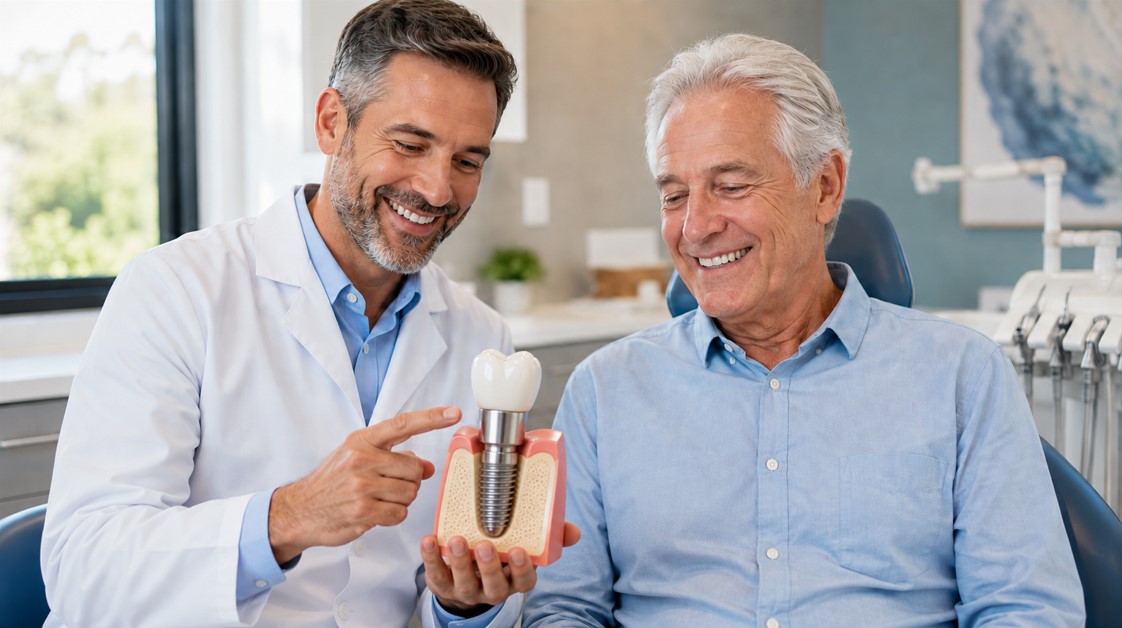
Missing teeth change more than your smile — they affect how you chew, speak, and feel about showing your teeth in photos. If you're comparing tooth replacement options, cost is usually the deciding factor, and it's also the most confusing part of the process. This guide breaks down exactly what dental implants cost in the United States in 2026, what drives the price up or down, and how real patients cover the bill.
How Much Do Dental Implants Cost?
A single dental implant — including the implant post, abutment, and crown — typically costs $3,000 to $6,000 in the United States. Prices run higher in expensive metro areas and lower in the Midwest and South. Full mouth implant treatment ranges from about $18,000 to $90,000 or more, depending on how many implants are placed and which restoration you choose.
A dental implant isn't a single line-item fee. It's a small system of parts — a titanium or zirconia post, a connector called an abutment, and a custom crown — plus the clinical work needed to place and restore it safely. That's why one dentist's "$999 implant" and another's "$4,500 implant" can both be accurate quotes for completely different things. Whether you're asking how much are dental implants or comparing a specific tooth implant cost between providers, the only way to know your real number is a clinical exam and imaging, since bone health, the tooth being replaced, and the materials you choose all move the price.
Average Dental Implant Cost in the USA
Nationally, a complete single-tooth implant averages $3,000 to $6,000, and full-arch options (All-on-4 or All-on-6) average $18,000 to $35,000 per arch. These figures reflect the total treatment, not just the implant post, and assume no major bone grafting is needed.
Location matters more than most patients expect. Practices in California, New York, and other high-overhead states tend to price 10–25% above the national average, while implants in the Midwest and South often land at or below it. Vacaville and the greater Sacramento–Bay Area corridor typically sit closer to the California average than to the national low end, though a consultation is the only way to know your specific cost.
Here's how average pricing compares across common treatment types:
Dental Implant Cost Breakdown
A complete implant is billed in stages: consultation and imaging, the implant post, the abutment, the crown, and — for some patients — preparatory work like an extraction, bone graft, or sinus lift. Understanding each line item is the best way to compare quotes accurately and spot a price that looks too good to be true.
Implant Fixture Cost
The implant fixture, or post, is the titanium or zirconia screw placed into the jawbone, where it fuses to bone through a process called osseointegration. It typically costs $1,000 to $3,000, with zirconia and premium brands like Nobel Biocare or Straumann priced above generic titanium options. This is the piece some clinics advertise as the whole "implant cost" — worth asking about directly, since the number alone doesn't include the abutment or crown.
Abutment Cost
The abutment is the small connector piece that attaches the crown to the implant post once healing is complete. Abutments generally run $300 to $1,000, with stock abutments at the lower end and custom-milled zirconia abutments — often used for a more natural gumline appearance — at the higher end.
Dental Crown Cost
The crown is the visible, tooth-shaped restoration and usually the single most expensive component after the post. Implant crown cost runs $800 to $3,000, depending on the material (porcelain-fused-to-metal versus all-zirconia or all-ceramic) and the lab fees for a natural-looking, custom shade match — the point where restorative and cosmetic dentistry goals overlap.
Consultation Cost
An initial consultation, including an exam and treatment plan, typically costs $50 to $250. Many practices, including NextGen Dental Smiles, apply this fee toward treatment if you move forward, or bundle it with the imaging appointment.
CBCT Scan Cost
A 3D CBCT (cone beam computed tomography) scan maps your jawbone, sinuses, and nerve locations before surgery. It runs $150 to $500 and is considered essential, not optional, for safe implant planning — a quote that skips imaging altogether is a red flag.
Tooth Extraction Cost
If the tooth being replaced is still present, extraction adds $150 to $650, with surgical extractions of impacted or broken teeth at the higher end. Placing the implant soon after extraction can sometimes lower the odds of needing a bone graft later.
Bone Graft Cost
Roughly half of implant patients need some bone grafting to rebuild a ridge that's shrunk since tooth loss. Bone graft cost ranges from $300 for a simple socket graft to $3,500 for larger ridge augmentation, depending on the graft material and the size of the area treated.
Sinus Lift Cost
For upper back teeth, thin bone near the sinus sometimes requires a sinus lift before an implant can be placed safely. This adds $1,500 to $5,000 per side and typically extends healing time by four to nine months before the implant itself can be placed.
Single Tooth Implant Cost
Replacing one missing tooth with a complete implant — post, abutment, and crown — costs $3,000 to $6,000 in most of the U.S. This is the most common implant case, and pricing is usually predictable once your dentist confirms whether you need a graft or extraction first.
Single tooth implant cost is also where "starting at" pricing causes the most confusion. A quote of $1,500 or less almost always covers just the implant post, not the full restoration. Ask for an itemized, all-in number — from consultation through final crown — before comparing prices between providers. Patients in Solano County can see local pricing context in our dedicated guide to dental implant costs in Vacaville, CA.
Multiple Dental Implant Cost
Replacing several missing teeth costs less per tooth than placing separate single implants, because the abutment work, imaging, and lab fees can often be shared across an implant-supported bridge. Two to four missing teeth in a row are commonly restored with implants supporting a connected bridge, rather than one implant per gap.
An implant-supported bridge replacing three teeth with two implants typically runs $5,000 to $15,000+, compared to roughly $9,000–$18,000 if each tooth were implanted individually. Your dentist will recommend the approach based on how the missing teeth are spaced and how much bone volume you have.
Full Mouth Dental Implant Cost
Replacing an entire arch of teeth with implants typically costs $18,000 to $35,000+ using the All-on-4 or All-on-6 technique, or $36,000 to $90,000+ to restore both arches. The wide range comes down to the number of implants, the prosthetic material (acrylic, hybrid, or monolithic zirconia), and whether grafting is needed.
All-on-4 uses four strategically angled implants to support a fixed, non-removable set of permanent teeth, often avoiding the need for a bone graft even in patients with some bone loss. We cover this technique, candidacy, and a full pricing breakdown in our dedicated guides to All-on-4 dental implants cost and All-on-4 dental implants cost in Vacaville, CA. For patients missing all or most of their teeth, our full mouth dental implants cost guide walks through every full-arch option side by side.
What Factors Affect Dental Implant Cost?
Your final price is shaped by eleven main variables: provider experience, location, materials, implant brand, whether you need bone grafting or a sinus lift, how many implants you need, the restoration type, digital planning technology, sedation, and lab fees. No two treatment plans price out identically because no two mouths are alike.
A few of these deserve extra explanation. An implant dentist's experience and specialty training can shift price significantly, often with fewer complications to show for it. Restoration type matters enormously, since a single crown and a full-arch zirconia bridge use the same implant technology but wildly different amounts of material and lab time. And digital technology like guided surgery adds cost upfront but reduces the chance of complications that would cost more to fix later.
Dental Implants Cost With Insurance
Most dental insurance plans classify implants as an elective or cosmetic procedure and don't cover the implant post itself, though some plans cover part of the crown or abutment. Even with coverage, annual maximums of $1,000 to $2,000 per year rarely make a meaningful dent in a $3,000-plus treatment.
A few things worth checking before you assume insurance won't help at all:
• Some PPO plans cover 40–50% of "major restorative" work up to the annual cap
• Medicare does not cover dental implants in almost all cases
• Medicaid (Denti-Cal in California) coverage for implants varies by state and is limited
• Staging the surgical and restorative phases across two calendar years can sometimes let you use two annual maximums instead of one
• HSA and FSA funds can be used for implants since they qualify as a medical expense
Ask your dentist's office to run a benefits check before treatment starts. The answer depends on your specific plan, not on dental implants as a category.
Dental Implant Financing and Payment Plans
Because insurance rarely covers the full cost, most patients finance dental implants through a medical credit card, a dental-specific lender, or an in-house payment plan. None of these options is inherently better — the right choice depends on your credit profile and timeline.
• CareCredit and similar medical credit cards (Sunbit, Cherry) offer 0% interest if the balance is paid in full within a 6–24 month promotional window; missing that window triggers retroactive interest, often above 30% APR
• Dedicated dental lenders (Proceed Finance, LendingClub, GreenSky) fund larger full-mouth cases, sometimes up to $70,000, with fixed monthly payments
• In-house payment plans let you pay the practice directly over 3–12 months, often interest-free
• HSA/FSA pre-tax dollars reduce your effective out-of-pocket cost automatically
• Dental savings plans, typically $100–$200 per year, offer 10–30% off cash pricing at participating offices as an alternative to traditional insurance
NextGen Dental Smiles offers flexible financing options for implant treatment — ask during your consultation which structure fits your budget.
Affordable Dental Implants
Affordable doesn't have to mean lower quality — it means finding a legitimate way to lower cost without cutting corners on materials or the provider's skill. Real ways to reduce your total include combining insurance with financing, timing treatment across two benefit years, using HSA/FSA funds, and choosing a provider who handles both the surgical and restorative work in-house instead of referring you between multiple specialists.
What doesn't help: choosing a provider based on the single lowest quote in your area without confirming what's included. The cheapest number is almost always missing a component you'll be billed for later.
Why Cheap Dental Implants Can Cost More Later
An implant that fails from a rushed placement, a low-grade material, or a provider who doesn't coordinate surgery and restoration closely often has to be removed and redone — meaning the patient pays twice. The good news is that implant success rates are high, typically 90–95%+ over ten years, when the case is planned properly and placed by an experienced provider. Outcomes are strongly tied to case planning, bone assessment, and material quality, not to the lowest price in town.
Watch for these signals before choosing a provider on price alone:
• A quote with no CBCT scan included
• No clear plan for who places the implant versus who makes the crown
• Pressure to decide same-day without a full exam
• A price dramatically below every other quote you've received for the same treatment
A redo isn't just a second bill. It usually means additional bone grafting to repair the damage from a failed implant, which is a more complex — and more expensive — procedure than the original case would have been.
Dental Implants vs Dentures Cost
Dentures cost far less upfront, $1,000 to $3,500 per arch versus $18,000-plus for a fixed implant arch, but implants usually cost less over 15–20 years once you factor in relines, adhesives, and eventual denture replacement. Which option makes sense depends on your budget timeline as much as your dental needs.
Traditional dentures typically need full replacement every 5–10 years and a reline every 1–2 years to keep fitting properly, since the jawbone keeps changing shape underneath them. Implants, by contrast, actively preserve that bone. Beyond dollars, the day-to-day chewing ability difference between a fixed implant and a shifting denture is significant for many patients. If a fully fixed arch isn't in the budget, an implant-supported overdenture ($8,000–$20,000 per arch) is a middle option — it snaps onto several implants for far more stability than a traditional denture, at a lower cost than a fully fixed bridge.
Dental Implant vs Dental Bridge Cost
A traditional 3-unit bridge costs $2,000 to $4,500 upfront, roughly half the price of a single implant, but it typically needs replacing every 10–15 years while an implant can last 20–30-plus years. Over a 30-year period, two bridge replacements often add up to more than the one-time cost of an implant.
The difference that doesn't show up on a price tag: a bridge requires filing down the two healthy teeth on either side of the gap to anchor the crowns, while an implant stands on its own and leaves neighboring teeth untouched. For patients who want to avoid altering healthy teeth, that's often as important as the long-term cost math.
Are Dental Implants Worth the Cost?
Implants are widely considered the gold standard in restorative dentistry, and for most patients the higher upfront cost is worth it — the value comes from rarely needing a replacement, not from the procedure being flashy. Judged purely as an investment, a $4,500 implant that lasts 25 years works out to about $180 per year; a $2,500 bridge replaced twice over that same period costs closer to $7,500 total.
The harder-to-quantify value is jawbone preservation. Bridges and dentures don't stimulate the bone the way a natural tooth root does, so the jaw gradually loses density underneath them, which can complicate both oral health and future dental work. That's a cost most price comparisons leave out, but dentists see the consequences constantly in patients who waited. For patients prioritizing a long-lasting solution over the lowest upfront number, implants are usually the stronger investment.
Value isn't only about the biggest number, though. If your budget genuinely can't stretch to an implant right now, a well-done bridge or denture is a legitimate choice — the real goal is avoiding the tooth loss and bone loss that come from replacing nothing at all.
Hidden Costs Patients Should Know About
Beyond the post, abutment, and crown, ask specifically about sedation fees, temporary restorations, follow-up visits, and the possibility of a second procedure if healing doesn't go as planned. These are the line items that turn a $4,000 estimate into a $6,000 final bill.
• Sedation: Local anesthesia is usually included, but IV sedation or general anesthesia can add $500–$1,500+
• Temporary teeth: A temporary crown or denture worn while the implant heals sometimes carries a separate fee
• Follow-up visits: Most practices include healing checkups, but ask what's covered versus billed separately
• Medication: Antibiotics and pain management are typically a pharmacy cost, not part of the dental bill
• Revision surgery: If a graft doesn't take or an implant needs to be replaced, that's usually billed as a new procedure
The best protection against hidden costs is a written, itemized treatment plan before you commit to anything.
Frequently Asked Questions
Are dental implants covered by insurance? Rarely in full. Most dental plans classify implants as elective and don't cover the implant post, though some cover part of the crown or abutment. Annual benefit maximums are typically $1,000–$2,000, which covers only a fraction of most implant cases. Always confirm your specific plan's implant benefits before treatment.
What is the cheapest way to get dental implants? Combine HSA/FSA pre-tax dollars, a 0%-interest financing period, and — if uninsured — a dental savings plan for discounted cash pricing. Timing surgical and restorative phases across two insurance benefit years can also help. Avoid choosing a provider based on the single lowest quote without confirming it includes the full treatment.
Why are dental implants so expensive? The price reflects surgical placement, biocompatible materials (titanium or zirconia), a custom-milled crown, 3D imaging, and months of clinical planning across multiple appointments, not one quick procedure. You're paying for a small multi-part system, not a single item.
Are dental implants cheaper than dentures long-term? Often, yes. Dentures cost far less upfront but typically need replacement every 5–10 years plus regular relines, while an implant can last 20–30-plus years. Over a 15–20 year period, the total cost frequently favors implants, though upfront budget is still a real constraint for many patients.
Is a dental implant cheaper than a bridge? No — a traditional bridge costs less upfront, typically $2,000–$4,500 versus $3,000–$6,000 for an implant. However, bridges usually need replacing every 10–15 years, so the long-term cost gap narrows or reverses over a 20–30 year timeline.
Does insurance cover bone grafts? Sometimes, especially if the graft is billed as a separate, medically necessary procedure rather than bundled with the implant. Coverage varies significantly by plan, so it's worth asking your insurer to price the graft separately from the implant itself.
Why do dental implant prices vary so much between dentists? Because the final price bundles several independent variables, provider experience, geographic overhead, implant brand, restoration material, and whether grafting is needed, into one number. Two quotes for "a dental implant" can reasonably describe very different treatment plans.
Final Thoughts
There's no single honest answer to how much dental implants cost, only an honest range and the specific factors that move you within it. For most patients, a single tooth lands between $3,000 and $6,000, and full-arch treatment lands between $18,000 and $90,000, with insurance covering little and financing covering the gap.
The most reliable next step isn't more research, it's a consultation and CBCT scan that turns these national ranges into your actual number as part of a genuine smile restoration plan. NextGen Dental Smiles in Vacaville, CA offers implant consultations with transparent, itemized pricing and in-house treatment from surgical placement through the final crown, so you're working with one team instead of being referred between offices. Schedule a consultation to get a cost breakdown specific to your mouth.
Dental Implant Pricing at NextGen Dental Smiles
National pricing provides a helpful starting point, but every patient’s treatment cost is different. NextGen Dental Smiles & Implant Studio in Vacaville, California, offers implant treatment ranging from single-tooth replacement to implant-retained dentures and full-mouth restorations.
The office provides free implant consultations that include a complete oral evaluation and cone-beam CT scan. Because advertised starting prices may apply to specific parts or treatment packages, patients receive a personalized, itemized treatment plan explaining the implant post, abutment, crown, preparatory procedures and restoration costs.
Financing options are available for qualifying patients. Offers, prices and financing terms are subject to change, so patients should confirm current details when scheduling.
If you are in Vacaville, Fairfield, Dixon or another nearby Northern California community, schedule a consultation with NextGen Dental Smiles to receive a personalized dental implant cost estimate.




Get Started
Your Smile is Our Priority
Schedule an appointment with us today to discover the difference of advanced, proven technologies, a full suite of services, and exceptional quality in dental care – all tailored to give you a healthier, happier smile.
.svg)
.svg)
.svg)

.svg)

.svg)
.svg)
.svg)

.svg)